This year, I took a short trip out to Clare Island with my family. It wasn’t really a bird watching trip – but I did steal a couple of hours to scout out the island, so I can return in the future for a real visit.
Visiting an island to birdwatch introduces a new variable – the reliability of the boatman! Recently I drove three hours to catch a boat to an island (not Clare Island). I had confirmed the evening before. “For 1? 11am” came back the admittedly terse confirmation. I drove down the next morning. As I picked up a sandwich for my lunch and mentioned I was heading out to the Island, the locals in the shop looked at me doubtfully. “It’s okay, he texted me“, I said confidently. As I waited (and waited and waited) at the pier, the locals watched me sympathetically, like a sad guy in a restaurant who has been stood up on a blind date. Indeed, as I desperately checked my phone, the “For 1?” took on a more sarcastic tone. My texts and calls were not returned, and by noon I admitted defeat and headed back to my car. Ghosted by a boatman.
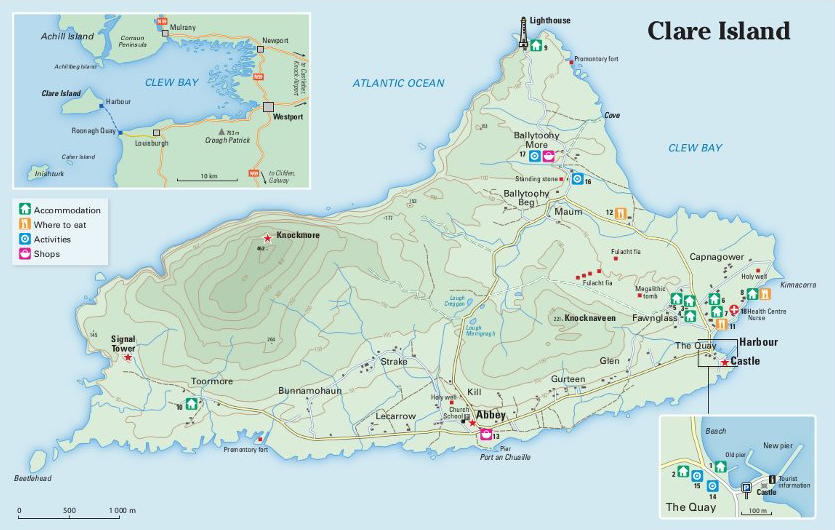
Thankfully the Clare Island Ferry is very reliable. The Clare Island Ferry company go from Achill to Clare Island twice a week – on Wednesdays and Fridays. The boat leaves Cloghmore pier in the morning, returning in the afternoon, which should be enough time to check out the key birdwatching spots. Cloghmore pier is just past one of Grainne Uaille’s castles. https://goo.gl/maps/pxnTZbsnF1DxRpSEA
I’ve never been a great seaman – even a moderate swell can turn me a bit green around the gills. The boat from Achill is small enough – it would hold 20 at a push, I’d say. But thankfully it was a calm enough day, when I headed over to scout around Clare Island.
We pulled out of Cloghmore pier, and headed through the gap between Achill and Corraun on the mainland. Sandwich Terns hovered nearby scouting for fish, and a Black Guillemot paddled on the water close to the boat. The boat trip takes about 30-40 minutes. Mid-journey a group of about 50 Manx Shearwater skimmed the waves close to the boat, with several Gannet plunging into the sea beside them. Gannet started breeding on the island back in 1975, and the site has grown in recent years.
When I arrived in the harbour I hired a bike to scout along the southern edge of the island. On the return boat journey I noticed that several people were bringing bikes with them, so next time I may bring my own bike. Near the quays there are the usual birds you would expect in a village in the west of Ireland – Meadow Pipit, House Martin, Swallows, and House Sparrow. As I cycled out to Gurteen, some more typical West of Ireland birds appeared – Wheatear and Stonechat flitting along the fence posts and stone walls, among flocks of juvenile starlings. Further on I heard the sound of Chough calling – I always think it sounds like somebody hitting a taut metal cable. They’re wonderfully aerobatic birds, and you see can see these red-billed crows tumbling around the face of the cliffs.
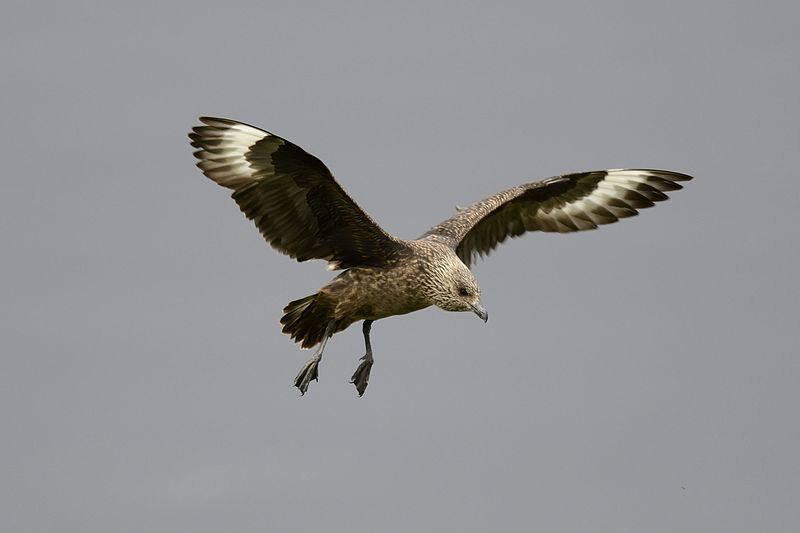
As the road nears the western end of the island at Toormore the mountains rear up steeply on your right, with Ravens and Hooded Crow soaring overhead. Here you can see the clear difference between areas where sheep have access – short, cropped grass, and stony, exposed soil – and where they do not – luxurious growth with orchids, vetch, clover, meadowsweet, and cranesbill. Further on, the road becomes a dirt track, heading to the Signal Tower. As I crossed a shallow, rocky stream, I ditched the bike. As I came over the crest of the hill, I immediately saw some seabirds on the updraft from the low cliffs in this area. With the binoculars I got a great view of a pair of Great Skua in the midst of several Fulmar. I took the opportunity to sit down beside the ruins of an old dwelling, and have a snack, while watching the Skua in action – powerful birds, chasing gulls and skua to steal their food, like a school bully in a playground. They’re known as the pirate of the skies – a suitable bird for Grainne Uaile’s island fortress.
Unfortunately, time was not on my side, and I needed to return to the Quay to catch the boat home. I got caught in a few quick showers on the way back. As the saying goes, you know when it’s summer in Ireland, because the rain feels warmer.
From what I was told, the main seabird colonies – Puffin, Razorbill, Guillemot, Fulmar and Kittiwake – are on the cliffs on the northern edge. The gannets nest on a sea stack about a kilometre north of the Signal Tower. I’m not sure if the best route to approach them is from the Signal Tower, or from the other direction – from the Lighthouse on the northern point of the island. Any advice would be welcome!

 BirdBrain
Hi, the best place to see the Gannett s are from the sea, we operate the ferry to the island and do regular chartered trips to see the Gannett s and the cliffs at the back of the island. As the rock on which they nest is small in size and the number of Gannett increasing yearly, they have moved up onto the cliff where they share with many other bird species in harmony.
Regards Alan O Grady. Clare Island ferry.
LikeLike