
Birding in the mountains can, let’s face it, be pretty boring. You can spend hours tripping across unhelpful tussocks, and all you have to show after a few hours are some Meadow Pipits and wet socks. For that reason, my preferred location in the Wicklow Mountains is Coronation Plantation.
It’s about 40 minutes by car from Dublin city, so I headed out on a recent spring morning. As the road climbed out of the city from Rathfarnham, I passed dozens of MAMILs (Middle Aged Men In Lycra), who for some masochistic reason were subjecting themselves to the lung-busting ordeal of cycling up steep hills. I approached the Sally Gap from the city, and could see my route veering off to the right along the edge of the mountain. Hooded Crow flying over the crossroads. There was a big fire around this area last year, and green shoots were only now coming through the blackened heather. The road crosses the river (which I believe is a tributary of the River Liffey) and shortly after that you’ll see an isolated house on the left hand side of the road. Just past the house, is the entrance to the Coronation Plantation, and you can park there – but you better be comfortable with hill starts!
As a light drizzle fell, I realised that my trusty waterproof trousers were back drying on the radiator at home. They must be at least 30 years old, and look it. Invariably, as I’m either pulling them on or off, some easily shocked genteel lady walks into view, but the genteel ladies of Wicklow were safe today. I then had my usual argument whether to bring my scope and tripod or not. If I didn’t bring it, I was more likely to see something incredibly rare in the far distance. I chose not to – and prayed that the car wouldn’t be broken into, which can be a risk in the mountains.
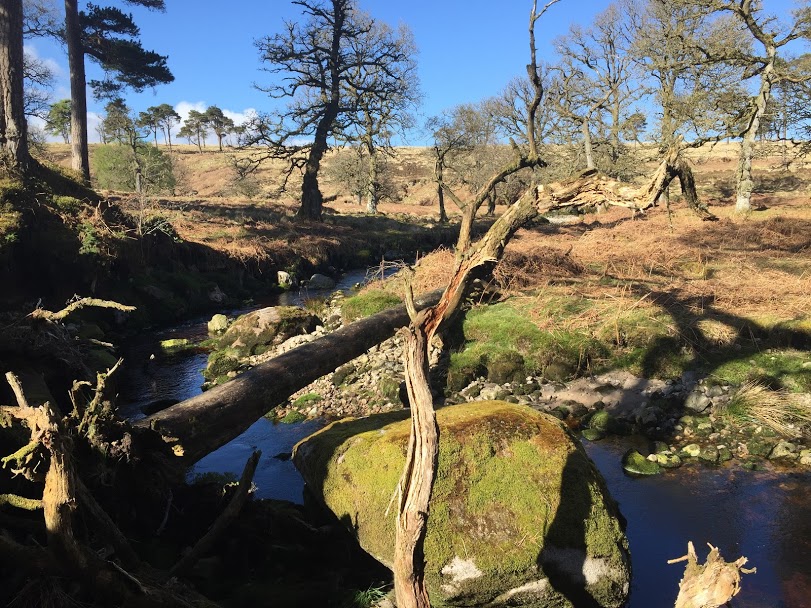
The stony track winds down alongside a rushing stream through a landscape of russet and yellow , and then joins the small rocky river. Brown, fast-flowing water – good for Grey Wagtail. Whinchat and Stonechat can be seen on the gorse (also known as Whin) around here also. Nothing today though, and the drizzle seemed to have dampened the birds spirits. I passed over the wooden bridge into the Scots Pine that make up the plantation. A squawk from the trees along the river signalled a Jay, and sure enough I saw a white rump disappear into the oak trees further on. Coal Tit, Goldcrest and Willow Warbler all called from the trees, so things were picking up.
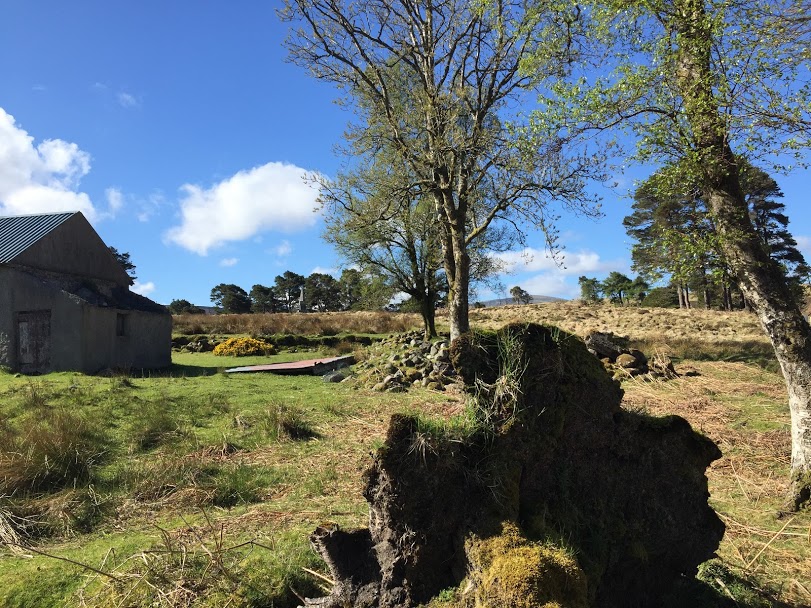
Amongst the trees, there’s an unoccupied cottage with a corrugated iron roof, and a flat mossy “lawn” around it. The lawn can be a good spot for Wheatear, and the bushes around the cottage are usually reliable for Whinchat, but not this time. I did however hear a Peregrine calling repeatedly, and sure enough, spotted him in the far distance perched on a dead tree (I knew I should have brought the scope!), but more about him in a future blogpost!
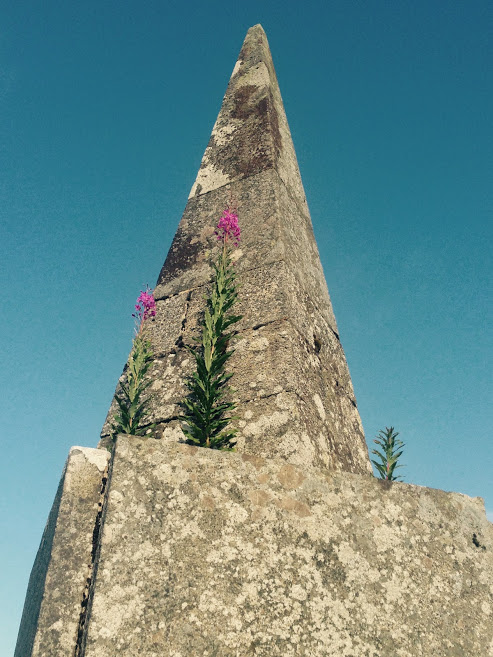
At that point I convinced myself I heard the “Go Back. Go Back” call of a Red Grouse, but on mature reflection, and after listening to some recordings, it turned out to be a Pheasant. As I went up to the Obelisk, in the distance I heard what sounded like a Blackbird clucking a warning. It sounded unusual – I figured either there was a predator that might be worth seeing, or that it wasn’t a Blackbird. Sure enough, after stumbling across the tussocky grass like a happy drunk, I saw a male Crossbill perched on top of a Scots Pine, calling away.
At that point I headed back to my car, which was thankfully untouched, but the broken glass on the gravel does serve as a warning not to leave valuables in your car. 20 species was good for a mountain jaunt, and it was my first Crossbill of the year, so happy out. I’ll return later in the season to see if I can get the Whinchat or Spotted Flycatcher, which are regular enough at this site.

 BirdBrain
About a month after my visit there was a fire at Coronation Plantation. It was the worst possible time, nesting season for many ground-nesting birds – Whinchat, Stonechat, Meadow Pipit. I haven’t been back yet to see what damage has been done. Sad news. https://www.thejournal.ie/deliberate-fire-wicklow-mountains-4640468-May2019/
LikeLike