July can be a quiet month for birdwatching, as many birds keep a low profile to look after their young. It can, however, be a good time to catch Green Sandpiper, a rare enough passage migrant in Ireland. Rogerstown Estuary is one of the most reliable spots for Green Sandpiper near Dublin.
Rogerstown is another birding gem near Dublin. There are multiple habitats in a relatively small area – meadows, woodlands, farmland, lakes, mudflats, saltmarsh, river and estuary. The Green Sandpipers hang out in the inner estuary on the south side of the river, so I’ll describe the rest of the site in a future blog post.
The car park is near enough Donabate village, and accessed easily from the M1 ( https://goo.gl/maps/bUWqTWga1U2R7Bt18 ). On one side of the car park are the allotments – full of finches and tits. On the other side there’s a council depot, surrounded by tall conifers, with Rooks, Jackdaw and Swallows wheeling around the tops of the trees, and Coal Tit and Goldcrest flitting through the branches. Straight ahead there’s a field which has been good for Barn Owl in recent years. Usually competitors from the Dublin Bird Race in January gather in the dark in this field at the end of the race, the odd face lit up in the glow of a cigarette, staring hopefully into the blackness for one last tick.
On this occasion I headed to the depot and turned left to follow the lane going down towards the Estuary. With overgrown hawthorn hedges and luxuriant verges, it’s more like a lane you’d find in Leitrim than in Dublin. As John McGahern would describe it – “ . . . the hawthorn foams into streams of blossom each May and June . . . in their branches the wild woodbine and dog rose give off a deep fragrance in the summer evenings, and on their banks grow the foxglove, the wild strawberry, primrose and fern and vetch among the crawling briars”
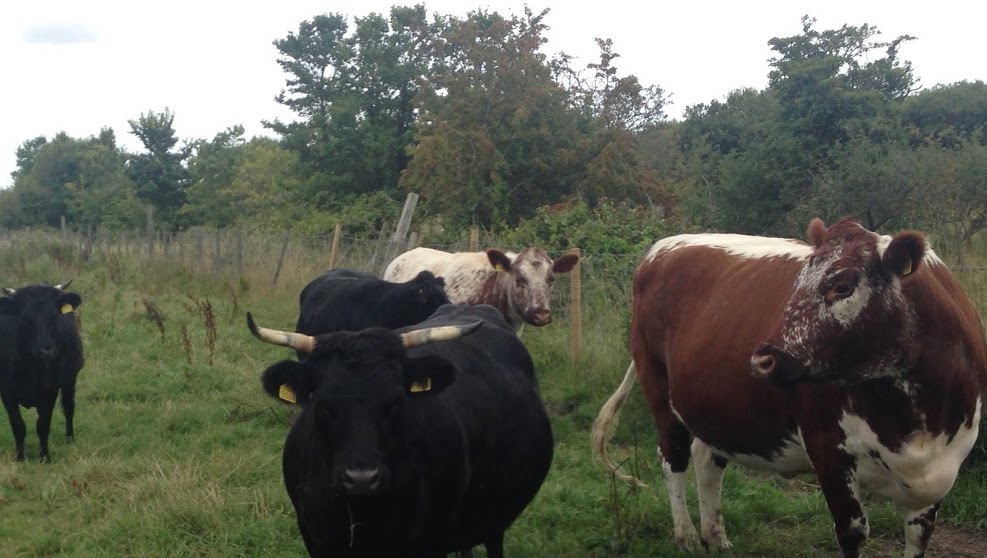
To get to the Southern Bird Hide, follow the road to the right, but to get to the Inner Estuary, I kept going straight down the lane. The lane turns left just beside a large pond. This was added a few years ago, and has provided a space for Sedge Warbler, Gadwall, and Little Grebe. Follow the road left and it terminates with a gate. With binoculars, tripod, scope and a rucksack hanging from me, I climbed this with all the grace and agility of a pig on stilts, eventually arriving on the other side without strangling myself on my binocular straps. The field is occupied by small black cows, with fairly sharp looking horns. They look quite like the black Camargue bulls, and hopefully they will attract similar birdlife to Rogerstown. They eyed me with interest, but couldn’t be bothered (thankfully) to check me out any closer. As I walked across the field, I checked out the three or four scrapes. In the past they have been good for Green Sandpiper and Shoveler, but not on this occasion – a Little Egret and a Heron were the only occupants, and an Irish Hare lolloped away from me across the field.
At the bottom of the field you can get a good enough view of the Inner Estuary. This is one of my old reliable spots for Kingfisher. Somebody with a sense of humour has tied a piece of azure baling twine to a branch upstream, and invariably I get an excited lurch as I think I’ve spotted a perched Kingfisher. Not so, but usually one will fly up or downstream during the visit. I’ve also seen Glossy Ibis here on a couple of occasions, and it’s also a good spot for Common Sandpiper, which I find increasingly uncommon around Dublin. No Common Sandpipers this time, but as I looked down the river I saw what looked like two large House Martins flying away from me – dark wings and a white rump – a classic view of Green Sandpiper. The two rose high into the air, and circled, giving a distinctive call. Several times I thought they would come back to land, but each time they rose up again and kept circling and calling. After several minutes they headed East towards the outer estuary.
I made my ungainly way back across the gates, and walked back to the car through the birch woods, with Willow Warbler and Blackcap quite prominent, and a pair of Bullfinches calling in an unexpectedly apologetic manner. A nice end to a birding trip.

 BirdBrain